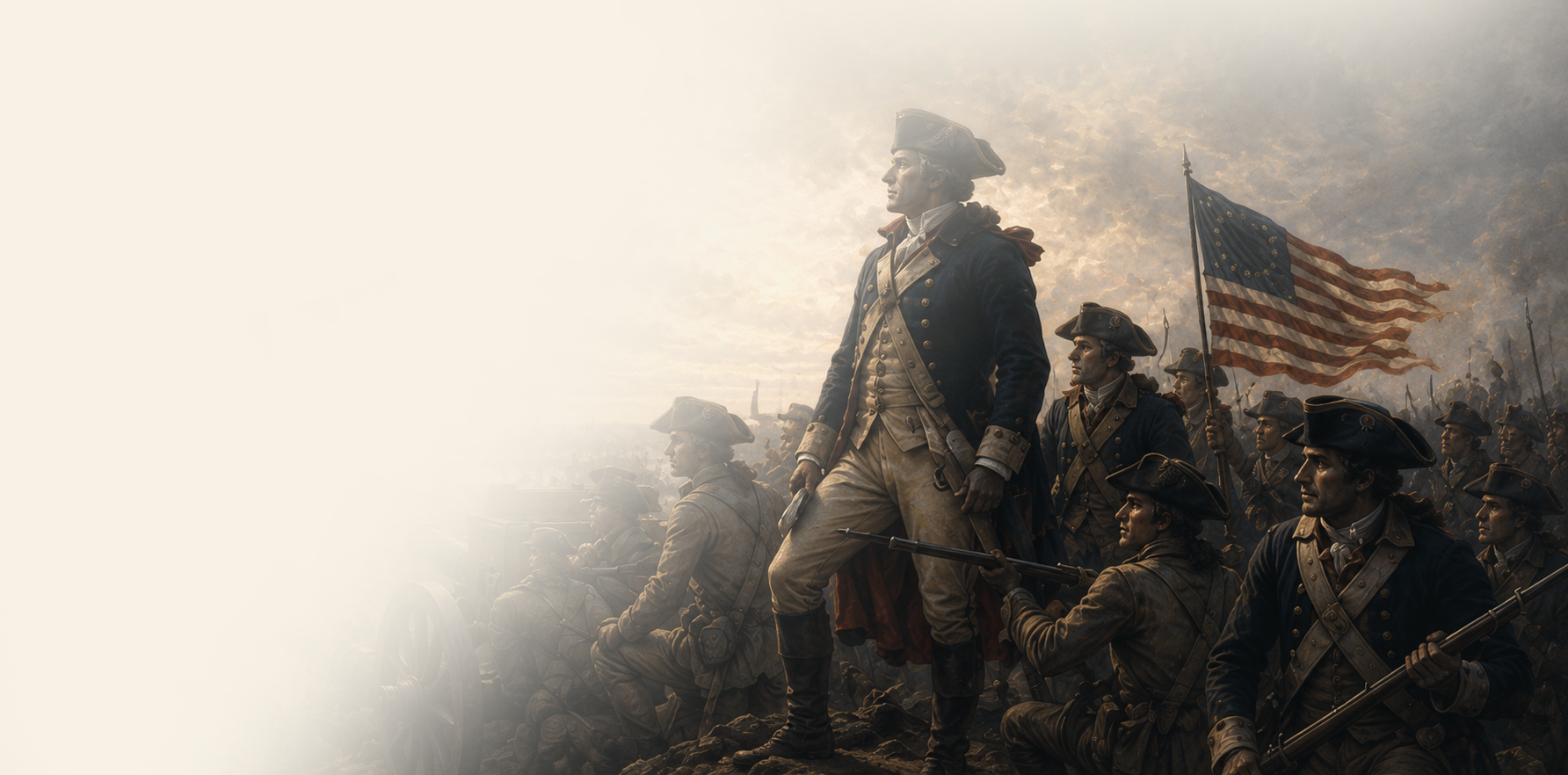
Explore the major battles and events of the Revolutionary War through a chronological timeline. From the first clashes in 1775 to the final peace in 1783, these moments shaped a nation and secured our freedom.
Filter By:
1763
February 10, 1763
Treaty of Paris Ends French & Indian War
The first Treaty of Paris ended the French and Indian War. France surrendered all North American possessions east of the Mississippi to Britain. The enormous cost of war led Britain to impose new taxes on the colonies — setting the stage for revolution.
1765
March 22, 1765
The Stamp Act
Parliament imposed the first direct tax on American colonists, taxing legal documents, newspapers, and even playing cards. The rallying cry "no taxation without representation" was born. Colonists boycotted British goods.
1770
March 5, 1770
Boston Massacre
British soldiers fired on a crowd in Boston, killing five colonists including Crispus Attucks. Paul Revere's famous engraving of the event inflamed Patriot opinion throughout the colonies.
1773
December 16, 1773
Boston Tea Party
Sons of Liberty disguised as Mohawk Indians boarded British ships and dumped 342 chests of tea into Boston Harbor. The audacious act of defiance united the colonies and hardened positions on both sides.
1774
September 5, 1774
First Continental Congress
Delegates from 12 colonies met in Philadelphia to coordinate resistance to the Intolerable Acts, agreeing to boycott British goods and petition the King.
September 1, 1774
Powder Alarm
British troops seized colonial gunpowder in Cambridge, Massachusetts. Though no shots were fired, tens of thousands of militia mobilized within hours — a rehearsal for the real thing.
"The shot heard round the world." Eight militiamen fell at Lexington Green. At Concord's North Bridge, colonists fired back — the first armed resistance to British authority. The British retreated to Boston harassed the entire way, suffering 273 casualties.
Ethan Allen and the Green Mountain Boys, joined by Benedict Arnold, captured the strategic fort without a fight. Its 78 cannon would be hauled to Boston by Henry Knox, forcing the British evacuation.
The Continental Congress unanimously appointed George Washington of Virginia as Commander-in-Chief of the Continental Army, beginning the transformation of colonial militia into a professional force.
June 17, 1775
Battle of Bunker Hill
Though a British victory, American defenders inflicted over 1,000 British casualties before running out of ammunition. The battle proved that Americans could stand against professional soldiers and discouraged British commanders from ever again launching frontal assaults.
British naval vessels bombarded and burned Falmouth (present-day Portland, Maine), destroying three-quarters of the town. The attack hardened colonial opinion against reconciliation with Britain.
Thomas Paine published Common Sense, arguing forcefully for American independence in plain language. It sold 500,000 copies and convinced many colonists that independence — not reconciliation — was the only path forward.
March 17, 1776
British Evacuate Boston
After Washington fortified Dorchester Heights with Knox's cannon from Ticonderoga, British General Howe evacuated Boston by sea — never to return. The date is still celebrated as Evacuation Day in Massachusetts.
June 28, 1776
Battle of Sullivan's Island
Colonel William Moultrie's palmetto log fort repelled a British naval assault on Charleston after ten hours of bombardment. The battle protected Charleston for three more years and earned the palmetto its place on South Carolina's flag.
The Continental Congress formally adopted the Declaration of Independence, drafted primarily by Thomas Jefferson — proclaiming that "all men are created equal" and formally severing ties with Britain.
August 27, 1776
Battle of Long Island
The largest battle of the Revolutionary War. British forces outflanked Washington's army through an unguarded pass. Washington's brilliant nighttime retreat across the East River saved the Continental Army from destruction.
Though technically a British victory, Benedict Arnold's fighting retreat on Lake Champlain delayed Burgoyne's invasion by a crucial year — giving Americans time to prepare the Saratoga defenses.
Washington crossed the ice-choked Delaware River on Christmas night and surprised a Hessian garrison. The stunning victory revitalized the Continental Army at its lowest point and convinced men to re-enlist when the Revolution needed them most.
Following Trenton, Washington struck Princeton at dawn. The twin victories at Trenton and Princeton forced the British to abandon most of New Jersey and transformed the war's political situation.
General John Stark's New Hampshire militia destroyed two Hessian and Loyalist forces, killing or capturing nearly 1,000 of Burgoyne's troops. The victory foreshadowed Saratoga.
Howe outflanked Washington's position at Brandywine Creek, routing the Continental Army and opening the path to Philadelphia. The Marquis de Lafayette was wounded in his first battle.
Washington's audacious attack on the British camp at Germantown failed due to fog and poor coordination — but impressed French observers enough to accelerate their decision to ally with America.
The turning point of the war. Burgoyne's army of 6,200 surrendered after Benedict Arnold's inspired counterattack. The victory convinced France to formally ally with the United States, transforming the conflict into a world war.
Washington's army entered winter quarters at Valley Forge. About 2,500 men died of disease and exposure — but the survivors, drilled by Friedrich von Steuben, emerged as a professional army capable of winning the war.
1778
February 6, 1778
French Alliance
France formally recognized American independence and pledged military and financial support, secured by the Saratoga victory. The alliance transformed the war into a global conflict.
June 28, 1778
Battle of Monmouth
Fought as the British evacuated Philadelphia. After General Charles Lee's disastrous retreat, Washington personally rallied the army. Mary "Molly Pitcher" Hays became a legend here. The battle demonstrated the Continental Army's transformation.
John Paul Jones, commanding the Bonhomme Richard, defeated HMS Serapis in sight of the English coast. Jones's reply when asked to surrender — "I have not yet begun to fight!" — became immortal.
British forces captured Savannah, Georgia, beginning the British Southern Strategy. The fall of Savannah opened Georgia to British occupation and launched the most brutal phase of the war.
George Rogers Clark's audacious 240-mile winter march through flooded wilderness captured British Lt. Governor Henry Hamilton, securing the Northwest Territory for the United States.
"Mad Anthony" Wayne's midnight bayonet assault captured a heavily fortified British position on the Hudson River — one of the most brilliantly executed operations of the war.
The worst American defeat of the war. General Lincoln surrendered 5,466 soldiers — the largest American capitulation until the Civil War. The fall of Charleston opened the entire South to British occupation.
A catastrophic American defeat. General Gates fled 60 miles. German-born Baron de Kalb fought until shot eleven times. The Continental Army of the South was virtually destroyed.
Over-Mountain Men surrounded and destroyed a Loyalist force under Major Patrick Ferguson. Thomas Jefferson called it "the turn of the tide of success." The battle began the end of British power in the South.
Daniel Morgan's tactical masterpiece. Using militia as a deliberate lure, he destroyed Banastre Tarleton's elite force — killing, wounding, or capturing 86% of the British command. Combined with Kings Mountain, Cowpens shattered British power in the South.
A British victory that destroyed their ability to win the war. Cornwallis suffered 27% casualties. Charles James Fox declared in Parliament: "Another such victory would ruin the British Army."
The most strategically important naval battle in American history. French Admiral de Grasse defeated the British fleet, trapping Cornwallis at Yorktown. Without this victory, Yorktown would have been impossible.
Cornwallis's army of 8,087 marched out to surrender to Washington and Rochambeau. The British band reportedly played "The World Turned Upside Down." The American Revolution was effectively won.
One of the last major battles of the war. Kentucky militia rashly attacked a British-Indian force, suffering heavy casualties. Daniel Boone lost a son. The battle was one of the final acts of a war already won at Yorktown.
Great Britain formally recognized the independence of the United States. The new nation's borders extended from the Atlantic to the Mississippi River. The Revolution that had begun at Lexington and Concord eight years earlier was complete.
December 23, 1783
Washington Resigns His Commission
George Washington voluntarily resigned as Commander-in-Chief before Congress, surrendering military power to civilian authority. The act astonished the world and secured the Republic.